Saturday, January 24, 2009

Thursday, January 22, 2009

Flight 1549

I'm sure there will be more information to come in the future weeks regarding US Airways Flight 1549 and I'm sure I will have other reflections, but a few things stick out and are worth reading at present.

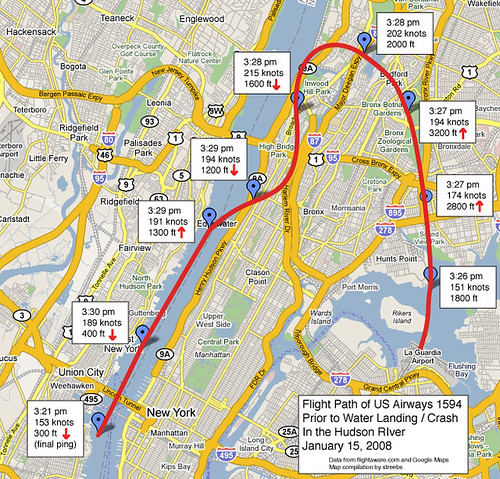
First, make sure you take a look at this visualization of the flight path based on the ATC reports available:


The path taken by the aircraft is quite remarkable--as is the entire incident--but the captains choice to not head back to LaGuardia and head for the Hudson (and the ability to miss all bridges, towers, transmission lines, helicopters, boats, and--not to mention additional geese--any other substantial traffic) is something that we may not see easily replicated.

Some of the events that occurred are the result of good training and planning (when able) as well as good engineering of the aircraft. [Read this great Wall Street Journal article for more background on the events from the perspective of aircraft systems and engineering.]

But not every result in this event came so because of skill or planning or even the right amount of decision-making. Even if you don't agree with John Piper's proclamation of God's planning amidst our lack of circumstantial control, it is worth pondering that our last President's tenure was marked and will be remembered by the unfortunate events related to 4 aircraft that were uncontrolled and unplanned by him. Will this President's tenure be marked and remembered by an omen of fortune involving an aircraft that was likewise outside the scope of his planning and control?

Tuesday, January 20, 2009

A white man's perspective on the celebration of the birth of Martin Luther King, Jr

(I wrote this yesterday, for yesterday, but post a day late, on the day of the inauguration of America's first black President)

Last night Jen and I were discussing where Martin Luther King, Jr falls in the scope of America’s most important historical figures. Without a doubt he is easily within the top-50. Most of our discussion was actually about what “historically important” means; while I maintain that Elvis’ contributions to American history are significant in scope, she maintains that they are by no means significant contributions. Nevertheless, Dr King fits all such criteria and we decided that the conversation is whether he is a top-10 or top-25 American historical figure.

I’m not sure where he fits and I won’t propose such (though suggestions are welcome), but what interests me most is how often this day is maligned. I understand that historically there has been much opposition to this day being an official American holiday (marked as a paid holiday for federal employees); many prominent politicians have opposed the holiday. Also, it is unique among holidays in that it celebrates someone who has never held political office and is the most recent of the national holidays.

I am young, so I've missed the historical arguments. In my memory, it has always been a holiday, though really the day began to be officially recognized in 1986. I know that the past discussions are not dismissed simply because this observation has been official for now over 20 years, but what confounds me is how people speak about the holiday. Just last week I heard in conversation, “If you only understood how much it means to them.” This morning I overheard someone joking on the phone with a client, “aren’t you taking the day off?” (as though there is hidden merit to working on this day).

Maybe I misunderstand the historical record, but I take Dr King’s work as that of uniting people across and despite of differences. His work was to represent and profit the rights of the oppressed and marginalized black society, but not for the purpose of nationalizing these communities into national prominence. To me, Dr King represents freedom and good will towards all men, not just black men, and his primary goal was that black men--and all men--would have a common standing among one another.

Certainly, his efforts have not yet been fully rewarded. After the recent Presidential election, in which America elected her first black President, many people reacted in what seems to me a very un-King-ly way. “We won!” or “we lost” or "what are they going to do to this country" may have been words spoken or heard depending on whether you are black or conservative; such Us-Them speech abounds today despite Dr King's efforts.

“We” too often speak poorly of “them”, whoever “they” may be, speaking with contempt or disdain or disgust but mostly I think with ignorance and bias. “We” too often don’t want to be reconciled with “them”. “We” don’t want “them” to have what “we” have. Or "we" want what "they" have and had and want to lord it over "them" just as "they" have for so long. “We” don’t want “them” to live near or threaten “our” kids. "We" don't want to be like "them" or "them" like "us".

This is what Dr King wanted us (all) to be rid of. I’m glad (and hope to grow in my appreciation) of what he did to unite the black communities in America against the injustices they’ve faced. More so I’m glad that his goal was not to unite “them” in order to gain the position of “us”, but to unite them with us so that we may be together a better and more responsible community.

We still have a long way to go. Yesterday I worked on the observation of the birth of Martin Luther King, Jr, not out of disrespect or because it wasn't a holiday for my organization, because the people in my office work (my company has 2 employees split into different offices). I worked as a sign of solidarity towards them.

But I look forward to the time when we all observe this day for the purpose of working towards and celebrating many of the same goals that this man sought after. I think these are good goals and I’m glad they’re goals for all of us and not just some of them.

I have a dream that one day this nation will rise up and live out the true meaning of its creed: 'We hold these truths to be self-evident, that all men are created equal.'

I have a dream that my four little children will one day live in a nation where they will not be judged by the color of their skin, but by the content of their character.

I have a dream that one day on the red hills of Georgia the sons of former slaves and the sons of former slave owners will be able to sit down together at a table of brotherhood.

Friday, January 16, 2009

Sometimes altruism is supplanted by the all-true-isms

Me: You should take those cookies to your grandmother when you go to visit her tonight. She'll enjoy that.
Jen: I ate the last two...
Me: The last two? Then Vicki must have had two today... because I took the other four to work this morning.

Thursday, January 15, 2009

The Challenge

During 2008 I challenged myself to read 30 books during the year. This number was somewhat arbitrary, but since I was turning 30 and wanted a significant challenge to myself, I chose the relatively difficult rate of 2.5 books per month.

I didn’t make it, but I enjoyed the experience. And I don’t think it’s inappropriate to knowingly set the bar high. When I was 26 I challenged myself to get in shape by committing to run a marathon. Granted, I was a runner previously, but at that time I was not in shape and had never run that far. And it worked out, though I was 27 by the time I raced the 26 miles.

So, last year I failed my resolution, though not too miserably. I didn’t actually commit to this at New Year’s, though it was early enough to count for the year. And I have enjoyed reading much more, though my discipline of reading regularly is not yet transformed. But I completed 12 books and started but have not finished another 11. I expect to finish these and more during the current year, with a slight twist on last year's pledge.

Without creating a challenge to myself this year, except to continue learning and enjoy the learning, I look forward to completing 12 new books this year (1 per month) while completing or re-reading 12 books (owned and unread also may count here, 1 per month), and listening to 12 new albums of music as well. For the latter, I have some ideas (as I intend to rely heavily upon un-sampled portions of Rolling Stone’s Top lists) but am very open to recommendations for any new item, book or music. If you have any suggestions, please provide them.

(So I guess, having set specific goals above, that this is a sort of challenge for 2009... )

Wednesday, November 12, 2008

Explaining the current financial crisis in a way my grandfather could never understand

Both of my grandfathers passed away in the 1990s before the dot.com and y2k bubbles burst, each to their own effects, and while alive each man was quite endearing in their own way. One of these grandfathers was a very clever man, a carpenter by trade, but a man who never assumed he knew anything more than you, unless it was how to pull a prank. He lived most of his life in South Arkansas and North Louisiana and when my family lived in a South-Dallas suburb he often would spend the afternoons of his visits in a lawn chair beside the garage, watching airliners enroute to land at Dallas Fort Worth International Airport.

Fortunately, an aircraft passed directly overhead every few minutes during the late afternoon hours and he would exclaim to me his wonder at how such a mass of aluminum and steel could fly through the air so gracefully and at such great speed.

Now I do know something about aircraft and how they fly but I must be honest and admit that I don't know very much about banking and the financial markets. And I don't think my grandfather, as aware of the human intent as he was, knew much more about banking than I. That said, I think if I could explain to my grandfather why an airplane doesn't crash, I think I could explain to him why a bank does.

As I again admit that I know little about banking, I think certain common assumptions and assertions are absolutely false. Any presumption that the current crisis is a result of the current President's lack of foresight or an evil machination of the Democratic party is at least ill thought and probably without good intent. What must we must remind ourselves is that banks don't simply hold money--banks make money by loaning your money out and having it repaid to them at a higher rate of interest than they pay you to hold it. Often banks are discussed as static in nature but are quite mobile--much like an airplane.

In flight, lift is produced by wings and propels the aircraft, my grandfather could regurgitate, but he struggled to grasp how tens of thousands of pounds of steel and aluminum could fly through the air in a manner that appears so graceful and gentle when all the while gravity was calling. And that's the secret of flying, for airplanes at least, not that gravity is defied but instead deferred.

Gravity's call is undeniable, but if the lift (and certain other physical properties) coordinate in such a way as to produce a rate of vertical propulsion equal to the rate of call by gravity then an aircraft may seem to float upon the air. So long as this relationship is balanced an aircraft may fly along for a seemingly endless period.

Most aircraft crashes are considered "controlled flight into terrain" (CFIT) and may occur when terrain is obscured by cloud or fog or when the climb or descent are not at the appropriate rate. In this case, gravity's call is often too great for the task at hand and the balance is not negotiated properly. This may seem analogous to some types of business failure, however this does not seem to fit the banking crisis.

And that sort of accident is not what people fear. What people fear is what my grandfather could not put to rest--what if lift all-of-a-sudden stopped? A slight imbalance between lift and gravity is not a big problem. This simply results in a climb or descent which, though potentially dangerous near the ground, is of little concern at 30,000 feet. This may be similar to normal business cycles during which profit may be greater or less than expected.

What most people fear--irrationally in most regards, I should add--is the stall, when lift is suddenly lost to such an extent that the immediate reaction by the aircraft is not descent but freefall. To varying degrees this situation is recoverable. For the Boeing 737, flying overhead at 33,000 feet and weighing roughly 130,000 lbs loaded up (not that weight has anything to do with lift, I just added that for drama), this situation is more dramatic.

Yet, this situation is not very likely. It could be the case that ice has accumulated along the wings such that airflow (and lift) is disturbed or a condition called clear-air turbulence (turbulence unassociated with normal weather phenomena) changes the flight conditions or, even worse, structural failure separates a wing. Any of these situations is as hazardous as it is unlikely, but the hazard is what sticks in peoples' minds and why many passengers are afraid of flying. The reality is that these situations, where the balance between lift and gravity is suddenly and tumultuously unraveled, is as unlikely as your bank failing.

Now here we are back at the beginning. How can a bank simply fail? How can so many bank executives not have known what they were doing? How can my bank with $300,000,000 in deposits be hopelessly in debt and insolvent? Debt, like gravity, is a harsh mistress and there seem to be times when a business cycle--though carefully planned in every regard--is disrupted much like an aircraft in sudden stall.

In that rare and unfortunate case it seems all that can be done is sit back and watch the bank fall like 130,000 lbs of steel and aluminum, out of the sky.

Tuesday, November 11, 2008

Would you wager on the existence of God?

That's whats being offered by a bookkeeper in the UK. The current odds are 4-1, which I understand means that there is an 80% chance that God exists. Although, the terms of the bet are very specific and payout is only made if, by scientific observation, God can be proved to exist.

That seems somewhat difficult and is probably why odds have dropped from 33-1 to the current 4-1. Still, 80% that God exists seems pretty good if you're an objective observer, but maybe someone with a better understanding of the philosophy of science can explain whether it is possible that an existence presumed to be immaterial or supernatural can be observed and proven by material and natural means.

Blogger Greg Mankiw observes this problem as he quotes author Robert Pirsig:

After a while he says, "Do you believe in ghosts?"

"No," I say.

"Why not?"

"Because they are un-sci-en-ti-fic."

The way I say this makes John smile. "They contain no matter," I continue, "and have no energy and therefore, according to the laws of science, do not exist except in people’s minds."

The whiskey, the fatigue and the wind in the trees start mixing in my mind. "Of course," I add, "the laws of science contain no matter and have no energy either and therefore do not exist except in people’s minds. It’s best to be completely scientific about the whole thing and refuse to believe in either ghosts or the laws of science. That way you’re safe. That doesn’t leave you very much to believe in, but that’s scientific too."


This is quite like the dilemma presented by Greg Bahnsen in his debate with Gordon Stein some years ago. Of course, neither Bahnsen nor Stein absolutely solved this issue--at least from a material perspective. But still, it seems that the existence of God is probably a safe bet, so long as you're not actually placing it.